Introduction
Tea is one of the world’s most widely consumed beverages and maintaining its chemical safety is an important part of quality assurance for producers, processors, importers and exporters.
Among the pesticide residues monitored in tea, glyphosate has received considerable attention because of its use as a herbicide and the increasing focus of international markets on pesticide residue compliance.
For tea businesses supplying domestic and export markets, glyphosate residue testing can form an important part of a comprehensive pesticide monitoring programme. Compliance should be assessed against the applicable Maximum Residue Level (MRL) for the specific market and commodity rather than relying only on a generic pesticide screening result.
What Is Glyphosate?
Glyphosate is a broad-spectrum herbicide used for weed management in agriculture. It is highly polar and has analytical characteristics that distinguish it from many conventional pesticide residues.
In tea production, potential residue concerns can arise from agricultural use, environmental exposure, or contamination associated with cultivation and handling practices.
Because tea is consumed after processing and brewing, residue monitoring is an important component of a broader tea safety programme.
Why Is Glyphosate Testing Important for Tea?
Tea exporters increasingly need to demonstrate compliance with destination-market pesticide requirements.
Testing for glyphosate can help businesses:
- Verify compliance with applicable MRLs
- Support export quality assurance
- Assess raw-material and supplier risks
- Identify residues before shipment
- Strengthen pesticide management programmes
- Support customer and buyer specifications
- Reduce the risk of non-compliant consignments
Importantly, glyphosate testing should not be viewed in isolation. Tea quality programmes generally benefit from comprehensive multi-residue pesticide screening combined with targeted analysis of compounds that are particularly relevant to the product or destination market.
Which Food Businesses May Be Impacted?
Businesses involved in the following products should evaluate the potential risk of PA and TA contamination:
- Tea and herbal infusions
- Herbs and spices
- Honey
- Botanical ingredients
- Nutraceuticals
- Food supplements
- Cereals and cereal-based products
- Seeds
- Plant-derived ingredients
For exporters supplying the European Union, monitoring these contaminants is increasingly important to support compliance and market access.
Glyphosate MRL Requirements for Tea
Growing scientific evidence has led regulators to strengthen controls on naturally occurring plant toxins.
India – FSSAI Requirements
FSSAI maintains a pesticide residue database specifying Maximum Residue Levels for different pesticides and food commodities.
The current FSSAI pesticide database lists 1 mg/kg as the MRL for glyphosate in tea. The database also defines the residue used for compliance purposes and distinguishes it from the residue definition used for dietary risk assessment.
However, manufacturers and exporters should always verify the latest applicable FSSAI requirement and regulatory status before making compliance decisions, as pesticide MRLs can be revised.
FSSAI also maintains regulatory provisions governing pesticide residues through the Food Safety and Standards (Contaminants, Toxins and Residues) Regulations, 2011, as amended.
EU Requirements for Tea Exporters
The European Union maintains a comprehensive regulatory framework for pesticide residues under Regulation (EC) No 396/2005.
The European Commission’s EU Pesticides Database allows users to search MRLs by pesticide and food commodity and is intended to provide information on the MRLs that apply to specific combinations of pesticide residues and food products.
For exporters, this means that tea should be assessed against the current EU MRL applicable to the relevant tea commodity and market requirement before shipment.
Why this matters
A tea consignment that complies with one country’s pesticide limit may not necessarily meet the requirements of another market. Therefore, exporters should establish testing specifications based on the destination market, buyer requirements and applicable regulatory limits.
Glyphosate Is Not the Only Pesticide of Concern
A common misconception is that testing only for glyphosate is sufficient to demonstrate tea pesticide compliance.
In practice, tea may be screened for a broad range of pesticide residues. A comprehensive tea pesticide programme can include:
- Herbicides
- Fungicides
- Insecticides
- Acaricides
- Growth regulators
Depending on the target market and risk assessment, laboratories may analyse hundreds of pesticide compounds using multiple analytical platforms.
This makes multi-residue pesticide testing an important component of export-oriented tea quality programmes.
How Is Glyphosate Tested in Tea?
Glyphosate has strong polarity and requires an analytical approach suitable for its chemical characteristics.
LC-MS/MS
Liquid Chromatography–Tandem Mass Spectrometry (LC-MS/MS) is widely used for sensitive and selective determination of glyphosate in food matrices. The general analytical workflow involves:
The general analytical workflow involves:
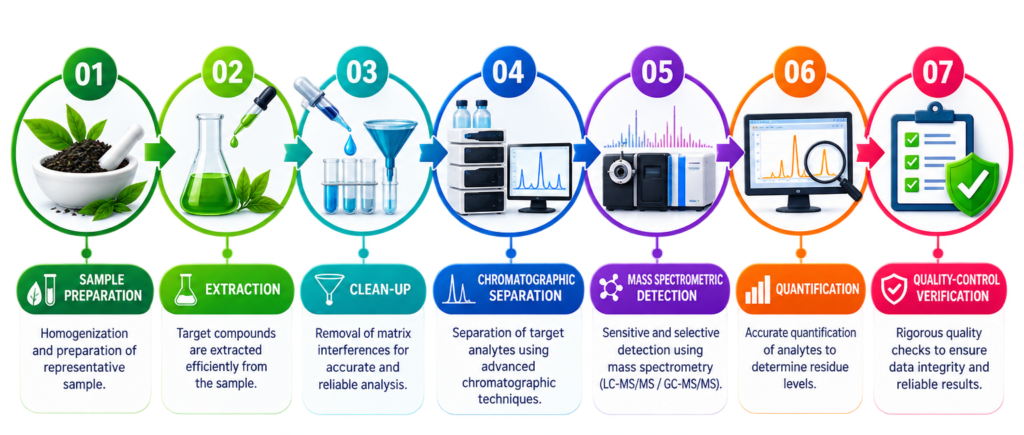
The analytical method should be appropriately validated for the tea matrix and demonstrate suitable performance for parameters such as:
- Specificity
- Accuracy
- Precision
- Recovery
- Linearity
- Limit of Detection (LOD)
- Limit of Quantification (LOQ)
Why LOQ Matters in Tea Testing
For export compliance, simply reporting that glyphosate is “detected” or “not detected” may not provide sufficient information.
The Limit of Quantification (LOQ) indicates the lowest concentration that can be reliably quantified using the analytical method.
A suitable method should have an LOQ appropriate to the regulatory limit or customer specification being assessed.
This is particularly important when exporters need to demonstrate compliance with stringent destination-market requirements.
Glyphosate vs. Multi-Residue Pesticide Testing
These are complementary approaches rather than alternatives.
- Glyphosate-Specific Testing
Useful when:
- A buyer specifically requests glyphosate testing.
- A grower has identified glyphosate as a particular risk.
- Previous testing indicates a potential concern.
- A destination market has specific requirements.
- Multi-Residue Pesticide Screening
Useful for:
- Routine tea quality monitoring.
- Export compliance.
- Supplier qualification.
- Risk-based surveillance.
- Broad pesticide residue assessment.
For many exporters, combining comprehensive multi-residue screening with targeted glyphosate analysis provides a stronger quality-control strategy.
What Can Tea Manufacturers and Exporters Do to Reduce Residue Risk?
Laboratory testing is only one part of pesticide residue management. Tea businesses should also consider:
Good Agricultural Practices
Follow appropriate pesticide application practices, including correct dosage, application timing, and pre-harvest intervals.
Supplier Control
Establish supplier qualification programmes and obtain appropriate pesticide-use information from tea producers and estates.
Traceability
Maintain records that allow raw materials to be traced back to their production source.
Risk-Based Testing
Increase monitoring for commodities, suppliers, or geographical areas where pesticide residue risk is higher.
Pre-Export Verification
Conduct appropriate laboratory testing before shipment to identify potential compliance issues before the product reaches the destination market.
How Eureka Supports Tea Manufacturers & Exporters
Eureka provides analytical testing solutions to help tea businesses verify pesticide residue compliance across domestic and international markets.
- Pesticide Residue Testing
- Glyphosate analysis
- Multi-residue pesticide screening
- Targeted pesticide analysis
- Export-oriented residue testing
- Advanced Instrumentation
- LC-MS/MS for suitable polar and non-volatile pesticide residues
- GC-MS/MS for suitable volatile and semi-volatile pesticide residues
- Tea Testing Support
Eureka can support:
- Tea manufacturers
- Tea estates
- Exporters
- Importers
- Traders
- Ingredient suppliers
- Private-label tea brands
- Compliance Support
Testing programmes can be designed around:
- FSSAI requirements
- Destination-market MRLs
- EU pesticide requirements
- Customer specifications
- Export quality-control programmes
By combining targeted and multi-residue analysis, Eureka helps tea businesses generate reliable analytical data to support product release, supplier verification and export compliance.
Why Exporters Should Test Before Shipment
Pesticide residue compliance should ideally be addressed before the consignment leaves the country of origin.
Pre-export testing can help businesses:
- Identify potential non-compliance early
- Prevent avoidable shipment delays
- Reduce commercial risk
- Support customer documentation
- Improve supplier control
- Demonstrate a proactive food safety approach
For high-value tea consignments, incorporating pesticide testing into the release process can be particularly valuable.
Key Takeaways
- Glyphosate is an important pesticide residue to monitor in tea.
- FSSAI's current pesticide database lists 1 mg/kg for glyphosate in tea.
- EU exporters should verify the current commodity-specific MRL using the applicable EU regulatory framework and pesticide database.
- Glyphosate requires an analytical approach appropriate to its chemical characteristics; LC-MS/MS is commonly used.
- Glyphosate-specific testing does not replace comprehensive multi-residue pesticide screening. A combination of good agricultural practices, supplier control, traceability and laboratory testing provides a stronger pesticide-residue management strategy.
Frequently Asked Questions (FAQ)
1. Is glyphosate testing mandatory for tea exports?
The requirement depends on the destination market, applicable MRLs, buyer specifications and the exporter’s quality-control programme. Exporters should verify the current regulatory requirements applicable to their specific tea product and destination.
2. What is the glyphosate MRL for tea in India?
FSSAI’s current pesticide database lists an MRL of 1 mg/kg for glyphosate in tea. Regulatory databases and applicable amendments should be checked periodically because MRL requirements can change.
3. How is glyphosate detected in tea?
Glyphosate can be analysed using LC-MS/MS, following suitable extraction and sample-cleanup procedures validated for the tea matrix.
4. Is glyphosate included in normal multi-residue pesticide testing?
It depends on the laboratory’s analytical scope and methodology. Because glyphosate has different chemical properties from many conventional pesticide residues, exporters should confirm specifically that glyphosate is included in the requested testing programme.
5. Why should tea exporters test for glyphosate before shipment?
Pre-export testing helps identify potential residue issues before the product reaches the destination market and supports regulatory compliance, customer requirements and risk management.
6. Can Eureka test tea for both glyphosate and other pesticide residues?
Yes. Eureka can support targeted glyphosate analysis as well as broader pesticide residue testing, using appropriate analytical platforms such as LC-MS/MS and GC-MS/MS.
Official References
- Commission Regulation (EU) 2023/915 on Maximum Levels for Certain Contaminants in Food
- Food Safety and Standards (Contaminants, Toxins and Residues) Regulations, 2011, as amended
- FSSAI – Pesticide Residue Standards and Food Product Data Portal
- Regulation (EC) No. 396/2005 on Maximum Residue Levels of Pesticides in or on Food and Feed of Plant and Animal Origin
- European Commission – EU Pesticides Database
- European Food Safety Authority (EFSA) – Pesticide Residue Risk Assessment
- Codex Alimentarius – Maximum Residue Limits for Pesticides (CXLs)