Introduction
Chlorate and perchlorate are inorganic oxyanion contaminants that can occur in food through environmental exposure, agricultural inputs, water, sanitation practices and food-processing operations.
Although their names are similar, chlorate (ClO₃⁻) and perchlorate (ClO₄⁻) are different substances and should be assessed separately.
The European Union has established specific regulatory controls for both substances. Chlorate is addressed through pesticide-residue legislation, with temporary Maximum Residue Levels (MRLs) established under Commission Regulation (EU) 2020/749, while perchlorate is regulated as a food contaminant under Commission Regulation (EU) 2023/915.
For food manufacturers, ingredient suppliers and exporters, monitoring these contaminants can be particularly relevant for products exposed to treated water, fertilizers, processing water or environmental sources.
What Is Chlorate?
Chlorate (ClO₃⁻) is an inorganic chemical ion that can occur as a by-product when chlorine-based disinfectants are used.
Although chlorate was historically associated with pesticide use, the European Commission notes that it is no longer approved as a pesticide in the EU. Current food residues are therefore largely associated with other sources, particularly the use of chlorine-based disinfectants in water treatment and food processing.
Potential sources include:
- Chlorinated drinking or processing water
- Sodium hypochlorite and other chlorine-based disinfectants
- Food-processing operations
- Irrigation water
- Agricultural and environmental exposure
- Residues associated with sanitation practices
The European Commission identifies drinking water as an important contributor to chlorate exposure in food.
What Is Perchlorate?
Perchlorate (ClO₄⁻) is a highly stable and water-soluble inorganic ion.
It can occur naturally in the environment and may also be associated with:
- Soil
- Groundwater
- Fertilizers
- Irrigation water
- Environmental contamination
- Chlorine-based water treatment
The European Commission identifies fertilizers, water and environmental sources as potential contributors to perchlorate contamination in food.
Because perchlorate is highly soluble, it can be taken up by plants through contaminated soil or water.
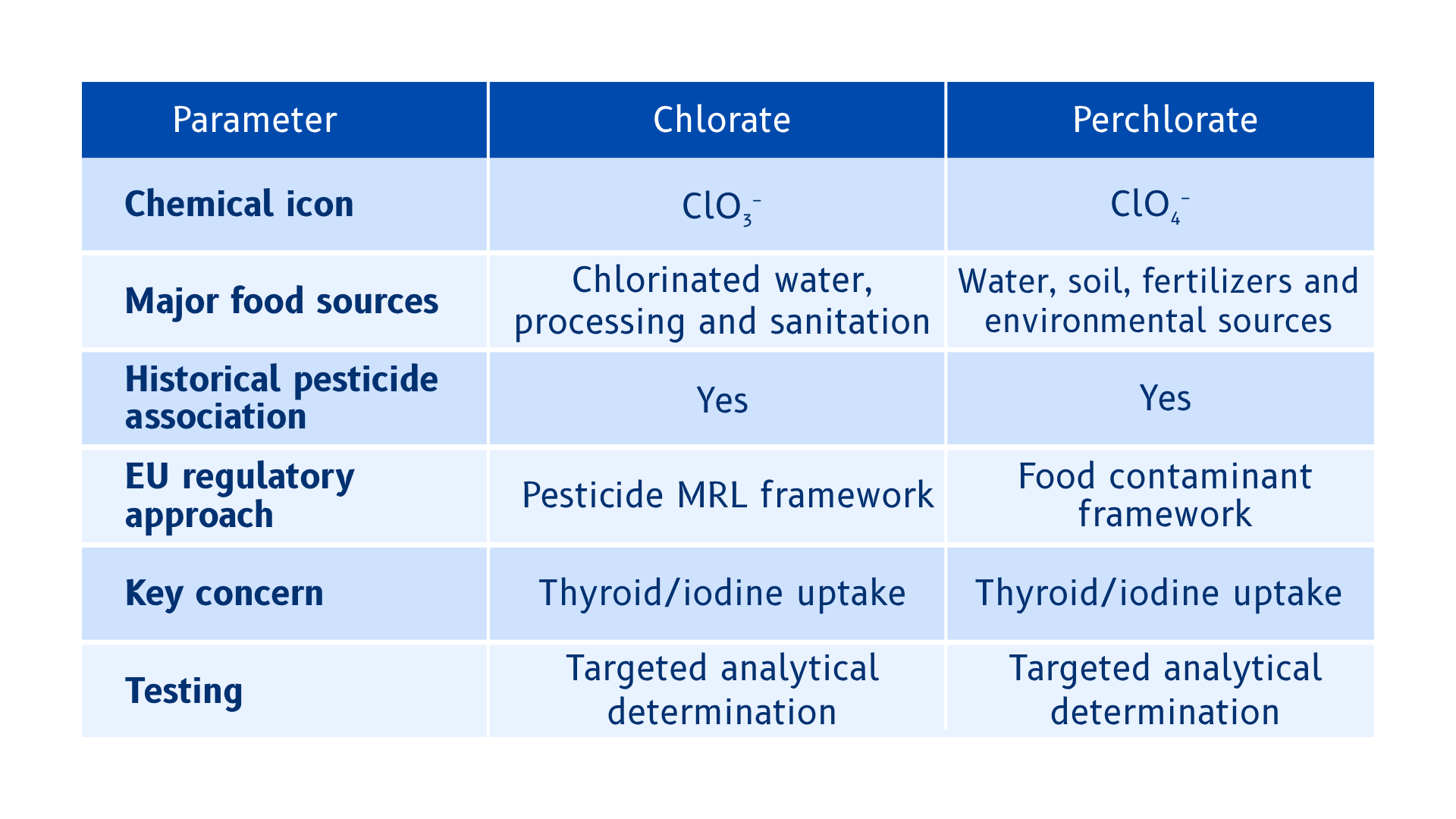
Chlorate vs Perchlorate: What Is the Difference?
The regulatory distinction is important because a laboratory report for one compound should not automatically be interpreted as covering the other.
Why Are Chlorate and Perchlorate a Food Safety Concern?
Both substances can interfere with iodine uptake by the thyroid.
The European Commission notes that elevated chlorate levels in food and drinking water can potentially affect thyroid function by inhibiting iodine uptake, with particular concern for infants and children.
Perchlorate has similarly attracted regulatory attention because of its potential effect on thyroid function and iodine uptake.
Consequently, food businesses need to consider these contaminants as part of their chemical safety and export-compliance programmes where relevant.
How Do Chlorate and Perchlorate Enter Food?
Contamination can occur at several stages of the food supply chain.
1. Water Used in Food Production
Water can be an important source of both contaminants.
Chlorate can be generated from chlorine-based disinfectants used in water treatment, while perchlorate can enter water from environmental, agricultural or industrial sources.
This makes water quality an important consideration for food manufacturers.
2. Food Processing
Chlorinated water may be used for:
- Washing
- Cleaning
- Processing
- Equipment sanitation
- Food-contact applications
If chlorine-based disinfectants contribute chlorate to the processing environment, residues may potentially remain in food.
Appropriate sanitation controls and water-quality monitoring can therefore help reduce risk.
3. Agricultural Sources
Perchlorate can be associated with fertilizers, soil and irrigation water.
The European Commission identifies fertilizers and water as potential sources contributing to perchlorate contamination in food.
4. Environmental Exposure
Both contaminants can occur through environmental pathways, making source identification important when elevated results are observed.
EU Regulatory Requirements for Chlorate
The European Union established commodity-specific chlorate MRLs through Commission Regulation (EU) 2020/749, which amended Annex III to Regulation (EC) No 396/2005.
The regulation explains that chlorate residues were frequently detected above the previous default MRL of 0.01 mg/kg, and that these levels could occur even when good practices were followed because chlorate can originate from disinfectant use rather than pesticide application.
Commission Regulation (EU) 2020/749 therefore introduced temporary, commodity-specific MRLs for chlorate.
The European Commission states that these MRLs have applied since 28 June 2020.
Important compliance point
The applicable chlorate limit depends on the specific food commodity.
Therefore, manufacturers and exporters should not apply a single generic chlorate limit to every food product.
EU Regulatory Requirements for Perchlorate
Perchlorate is regulated as a contaminant under Commission Regulation (EU) 2023/915 on maximum levels for certain contaminants in food.
The regulation establishes maximum levels for specific food categories.
For example:
- Fruits and vegetables: 0.05 mg/kg, subject to specified category-specific exceptions
- Leaf vegetables and herbs: 0.50 mg/kg
- Tea (Camellia sinensis), dried product: 0.75 mg/kg
- Dried herbal and fruit infusions: 0.75 mg/kg
- Infant formula and certain foods for infants and young children: lower limits apply.
Tea is particularly relevant
For dried tea (Camellia sinensis), the current EU maximum level for perchlorate is 0.75 mg/kg under Regulation (EU) 2023/915.
This makes perchlorate testing a relevant consideration for tea exporters targeting the EU market.
Chlorate and Perchlorate in Tea
Tea is an important example where both contaminants may need consideration.
Tea plants can potentially be exposed to contaminants through:
- Irrigation water
- Agricultural inputs
- Soil
- Processing water
- Environmental exposure
For exporters, testing should therefore be aligned with the destination market and the current commodity-specific regulatory requirements.
For perchlorate, the EU has an explicit maximum level of 0.75 mg/kg for dried tea.
For chlorate, the applicable requirement should be checked against the current EU pesticide MRL framework for the relevant commodity.
Chlorate & Perchlorate in Food Processing
Food manufacturers should pay particular attention to the quality of water used during processing.
Water management should consider:
- Source of water
- Chlorination/disinfection process
- Disinfectant type
- Storage conditions
- Processing-water quality
- Cleaning and sanitation practices
- Frequency of water testing
The objective is not necessarily to eliminate chlorine-based sanitation, but to ensure that sanitation practices do not unintentionally introduce unacceptable levels of chlorate into food.
How Are Chlorate and Perchlorate Tested?
Because chlorate and perchlorate are highly polar inorganic ions, analytical methods need to be appropriately selected for reliable low-level determination.
Liquid Chromatography coupled with Tandem Mass Spectrometry (LC-MS/MS) is commonly used for targeted analysis of these compounds in food matrices.
A typical workflow involves:
Sample Homogenisation → Extraction → Clean-up → Chromatographic Separation → MS/MS Detection → Quantification → Quality Control
The method should be appropriately validated for the relevant food matrix and reporting requirement.
Why LC-MS/MS Is Important
LC-MS/MS provides:
- High sensitivity
- High selectivity
- Compound-specific detection
- Low-level quantification
- Suitable performance for complex food matrices
- Simultaneous determination of multiple polar contaminants
For export testing, the analytical method should provide a sufficiently low Limit of Quantification (LOQ) relative to the applicable regulatory limit.
Important Analytical Parameters
A reliable chlorate and perchlorate testing programme should consider analytical performance characteristics such as:
- Specificity
- Accuracy
- Precision
- Recovery
- Linearity
- Limit of Detection (LOD)
- Limit of Quantification (LOQ)
- Matrix effects
- Measurement uncertainty
- Quality-control performance
The analytical method should be demonstrated as fit for the intended food matrix and regulatory application.
Why LOQ Matters for Export Compliance
A result reported simply as “not detected” may not provide enough information to establish compliance.
The LOQ determines the lowest concentration that can be reliably quantified by the method.
This is especially important when:
- Regulatory limits are low
- Customer specifications are stringent
- The product is intended for export
- Regulatory authorities require sensitive analytical methods
The European Commission’s earlier perchlorate monitoring approach specifically emphasized low analytical LOQs, including a target of 20 µg/kg for dried herbs, spices and tea for infusion.
Current testing specifications should nevertheless be established against the applicable regulatory requirements and validated analytical capability.
When Should Food Businesses Test for Chlorate & Perchlorate?
Testing can be incorporated into several stages of a food safety programme.
Useful for high-risk commodities and ingredients.
Testing can form part of supplier approval and periodic verification.
Water used in processing can be assessed where chlorate or perchlorate is identified as a potential risk.
Testing may be performed to verify compliance with applicable regulatory or customer specifications.
Particularly useful for products destined for markets with specific maximum levels.
Targeted analysis can help identify potential sources when elevated results are detected.
How Can Manufacturers Reduce Chlorate & Perchlorate Risks?
Laboratory testing should be combined with preventive controls.
Monitor water used in food processing and understand the treatment process.
- Review Disinfection Practices
Evaluate chlorine-based sanitation processes and their potential contribution to chlorate formation.
- Assess Agricultural Inputs
For products such as tea, fruits, vegetables and herbs, consider fertilizer, soil and irrigation-water risks.
- Strengthen Supplier Controls
Include relevant chemical-contaminant requirements in supplier specifications.
Retain records linking finished products to raw materials, suppliers and processing batches.
Testing frequency should be determined based on commodity, supplier history, processing conditions and destination-market requirements.
How Eureka Supports
Eureka supports food manufacturers, ingredient suppliers and exporters with analytical testing for chemical contaminants relevant to domestic and international markets.
Chlorate & Perchlorate Testing
Relevant Food Matrices
Depending on the testing requirement, analysis can support products such as:
Export Compliance Support
Testing programmes can be aligned with:
Eureka can help businesses generate analytical data to support quality control, regulatory assessment, supplier monitoring and export compliance.
Chlorate & Perchlorate Testing: A Risk-Based Approach
An effective control programme can follow the sequence:
Identify Sources → Assess Commodity Risk → Evaluate Water & Processing → Select Appropriate Testing → Verify Results → Investigate Deviations → Maintain Traceability
This approach helps manufacturers move beyond simply testing finished products and instead identify potential contamination sources throughout the supply chain.
Frequently Asked Questions (FAQ)
1. What is chlorate in food?
Chlorate is an inorganic ion that can occur in food, particularly through the use of chlorine-based disinfectants in water treatment and food processing.
2. What is perchlorate in food?
Perchlorate is a highly stable and water-soluble inorganic ion that can enter food through environmental sources, fertilizers, soil and water.
3. Are chlorate and perchlorate the same?
No. They are chemically different substances and are subject to different regulatory frameworks in the EU.
4. What is the EU limit for perchlorate in tea?
The current EU maximum level for perchlorate in dried tea (Camellia sinensis) is 0.75 mg/kg under Regulation (EU) 2023/915.
5. What is the EU limit for chlorate in food?
There is no single universal chlorate limit for all foods. The EU establishes commodity-specific MRLs under the applicable pesticide-residue framework. Exporters should verify the limit for the specific commodity.
6.How are chlorate and perchlorate detected?
Targeted analysis can be performed using liquid chromatography coupled with tandem mass spectrometry (LC-MS/MS), with a method appropriately validated for the food matrix.
7.Why should tea exporters test for perchlorate?
Tea is specifically covered by the EU contaminant regulation, which establishes a maximum level of 0.75 mg/kg for dried tea. Testing can therefore support EU export compliance.
8. Can chlorate and perchlorate be tested together?
Yes. Depending on the laboratory’s validated analytical scope, both compounds can be included in a targeted analytical programme.
9. Can processing water contribute to chlorate contamination?
Yes. The European Commission identifies chlorine-based disinfectants used in water treatment and food processing as important potential sources of chlorate.
10. How can Eureka support chlorate and perchlorate compliance?
Eureka can support manufacturers and exporters with targeted chlorate and perchlorate analysis for relevant food matrices, helping with supplier verification, quality control, regulatory assessment and pre-export compliance.
Official References
Conclusion
Chlorate and perchlorate are increasingly relevant chemical contaminants for food manufacturers and exporters, particularly where products are exposed to treated water, agricultural inputs or food-processing operations.
For EU-facing businesses, compliance requires more than simply testing for “chlorine-related contaminants.” Chlorate and perchlorate need to be considered separately, with the applicable regulatory limit determined according to the specific food commodity and destination market.
A comprehensive approach combining water-quality management, sanitation controls, supplier qualification, traceability and validated laboratory testing can help manufacturers identify and manage contamination risks.
For products such as tea, spices, herbs, fruits, vegetables and food ingredients, targeted chlorate and perchlorate testing can provide valuable analytical evidence to support quality assurance and export compliance.