Introduction
What Are Mycotoxins?
Mycotoxins are secondary metabolites produced by certain fungi that can grow on crops and food products.
Mould growth and mycotoxin formation can occur:- Before harvest
- During harvesting
- During drying
- During transportation
- During storage
- During processing
Major Mycotoxins Found in Food
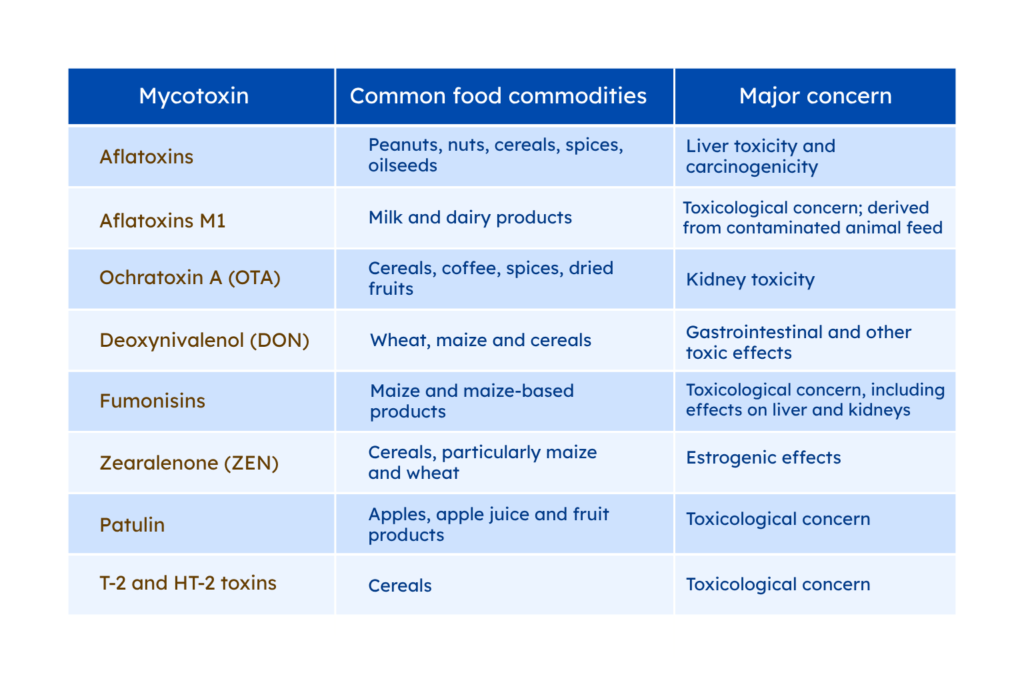
Aflatoxins: One of the Most Important Mycotoxin Groups
- Aflatoxin B1
- Aflatoxin B2
- Aflatoxin G1
- Aflatoxin G2
- Peanuts
- Tree nuts
- Maize
- Cereals
- Oilseeds
- Spices
- Dried foods
Aflatoxin M1 in Milk
- Raw milk
- Processed milk
- Dairy products
- Milk powder
Ochratoxin A (OTA)
- Cereals
- Cereal products
- Coffee
- Dried fruits
- Spices
- Grape products
- Other stored commodities
Deoxynivalenol (DON)
- Wheat
- Maize
- Barley
- Other cereals
DON is particularly associated with Fusarium infection of crops.
Monitoring can be important for cereal-based ingredients and finished products, particularly where raw materials are sourced from regions or seasons with elevated fungal risk.Fumonisins
Fumonisins, particularly fumonisin B1 and B2, are commonly associated with maize and maize-based products.
Their occurrence is influenced by fungal infection and environmental conditions during crop production and storage.Zearalenone
- Wheat
- Maize
- Barley
- Cereal products
- Cereal-based ingredients
Patulin
- Apples
- Apple juice
- Apple puree
- Fruit preparations
- Other fruit products
Health Risks Associated with Mycotoxins
- Type of mycotoxin
- Concentration
- Duration of exposure
- Frequency of consumption
- Individual susceptibility
- Age
- Nutritional status
- Aflatoxins: Liver toxicity and carcinogenicity
- Ochratoxin A: Kidney toxicity and possible developmental/immune effects
- DON: Gastrointestinal and other toxic effects
- Fumonisins: Toxicological effects affecting multiple biological systems
- Zearalenone: Estrogenic effects
- Patulin: Toxicological effects associated particularly with contaminated fruit products
EU Regulatory Requirements for Perchlorate
- Before Harvest
- During Harvest
- During Drying
- During Storage
- During Transportation
Can Mycotoxins Be Removed by Processing?
Not always.
One of the important challenges with mycotoxins is their chemical stability. WHO notes that many mycotoxins can survive food processing. Therefore, food businesses should not assume that:
Processing automatically eliminates mycotoxin contamination.
The most effective strategy is generally to prevent or minimize contamination at the agricultural, drying and storage stages and then verify compliance through appropriate testing.Regulatory Limits for Mycotoxins
Mycotoxin limits are not universal.
The applicable maximum level depends on:- Mycotoxin
- Food commodity
- Product category
- Intended use
- Destination market
- Applicable legislation
- Mycotoxin Regulation in India
In India, mycotoxins are addressed primarily under the Food Safety and Standards (Contaminants, Toxins and Residues) Regulations, 2011, as amended.
FSSAI’s regulatory framework includes limits for contaminants and naturally occurring toxic substances, including aflatoxins, aflatoxin M1, patulin and other relevant substances.- EU Regulatory Requirements
The regulation establishes commodity-specific maximum levels for relevant contaminants, including several mycotoxins.
Depending on the commodity, EU controls can cover substances such as:- Aflatoxins
- Ochratoxin A
- Deoxynivalenol
- Zearalenone
- Fumonisins
- T-2 and HT-2 toxins
- Patulin
The applicable level must be checked against the specific product category and current version of the regulation.
For exporters, this is particularly important because the same mycotoxin may have different limits depending on the food category.- Codex International Standards
However, national and regional regulations may establish different requirements.
Therefore:
Codex ≠ automatically applicable legal limit in every country.
Exporters should always check the legislation of the destination market.How Are Mycotoxins Tested?
Liquid Chromatography-Tandem Mass Spectrometry (LC-MS/MS) provides highly selective and sensitive determination of multiple mycotoxins.
It can be particularly useful for multi-mycotoxin screening, where several compounds need to be analysed simultaneously.Techniques such as ELISA may be used for screening applications.
Where regulatory or confirmatory analysis is required, an appropriate validated instrumental method may be necessary.Multi-Mycotoxin Testing
- Aflatoxin B1
- Aflatoxin B2
- Aflatoxin G1
- Aflatoxin G2
- Aflatoxin M1
- Ochratoxin A
- DON
- Zearalenone
- Fumonisins
- T-2 toxin
- HT-2 toxin
- Patulin
Why Sampling Is Critical in Mycotoxin Testing
An excellent analytical instrument cannot compensate for a poorly representative sample.
For this reason, appropriate sampling and homogenisation procedures are critical components of a mycotoxin testing programme.Important Analytical Parameters
- Specificity
- Accuracy
- Precision
- Recovery
- Linearity
- Limit of Detection (LOD)
- Limit of Quantification (LOQ)
- Matrix effects
- Measurement uncertainty
- Quality-control performance
When Should Food Businesses Test for Mycotoxins?
- Good Agricultural Practices
- Proper Drying
- Controlled Storage
- Pest Management
- Supplier Controls
- Traceability
- Risk-Based Testing
How Eureka Supports Mycotoxin Testing
- Aflatoxins
- Aflatoxin M1
- Ochratoxin A
- Deoxynivalenol (DON)
- Fumonisins
- Zearalenone
- T-2 and HT-2 toxins
- Patulin
- Other relevant mycotoxins
- Cereals
- Pulses
- Spices
- Nuts
- Oilseeds
- Dried fruits
- Coffee
- Fruit products
- Milk and dairy products
- Processed foods
- Food ingredients
- Nutraceutical and botanical ingredients
- Raw-material qualification
- Supplier verification
- Batch-release testing
- Regulatory compliance
- Pre-export testing
- Customer specification testing
- Contamination investigation
- Risk-based monitoring programmes
Building a Risk-Based Mycotoxin Control Programme
Key Takeaways
- Mycotoxins are naturally occurring toxins produced by certain moulds.
- Major food-related mycotoxins include aflatoxins, OTA, DON, fumonisins, zearalenone and patulin.
- Mycotoxin contamination can occur before harvest and during drying, storage and transportation.
- Many mycotoxins can remain stable during food processing.
- Aflatoxin B1 is a major food-safety concern because of its liver toxicity and carcinogenicity.
- Regulatory limits vary according to the mycotoxin, commodity and destination market.
- India regulates relevant mycotoxins under the FSSAI Contaminants, Toxins and Residues framework.
- The EU establishes commodity-specific maximum levels under Regulation (EU) 2023/915.
- LC-MS/MS can support sensitive multi-mycotoxin analysis.
- Sampling and homogenisation are critical because mycotoxin contamination can be unevenly distributed.
- Effective mycotoxin control combines supplier management, agricultural controls, proper drying and storage, representative sampling and laboratory testing.
Frequently Asked Questions (FAQ)
1. What are mycotoxins?
2. Which foods are commonly affected by mycotoxins?
3. What are the most important mycotoxins in food?
4. Are mycotoxins destroyed during food processing?
5. What is the regulatory limit for mycotoxins?
6. How are mycotoxins detected?
7. Why is sampling important for mycotoxin testing?
8. Should exporters test mycotoxins before shipment?
9. Can multiple mycotoxins be tested together?
10. How can Eureka support mycotoxin testing?
Official References
- Food Safety and Standards Act, 2006
- Food Safety and Standards (Contaminants, Toxins and Residues) Regulations, 2011, as amended
- FSSAI – Compendium of Food Safety and Standards (Contaminants, Toxins and Residues) Regulations
- Commission Regulation (EU) 2023/915 on maximum levels for certain contaminants in food
- Regulation (EC) No 1881/2006 – Maximum levels for certain contaminants in foodstuffs (historical framework; replaced by Regulation (EU) 2023/915)
- Codex Alimentarius Commission – General Standard for Contaminants and Toxins in Food and Feed (CXS 193-1995)
- FAO/WHO Joint Expert Committee on Food Additives (JECFA) – Mycotoxin Risk Assessments
- World Health Organization (WHO) – Mycotoxins
- International Agency for Research on Cancer (IARC) – IARC Monographs on the Evaluation of Carcinogenic Risks to Humans
Conclusion
A robust control strategy should therefore combine preventive measures with appropriate analytical verification.
For manufacturers and exporters, the key is not simply to ask “Is my product tested for mycotoxins?” but rather:By combining supplier controls, proper storage, representative sampling and validated laboratory analysis, food businesses can strengthen mycotoxin risk management and support safer, more compliant products.
Eureka Analytical Services can support this process through risk-based mycotoxin testing, multi-mycotoxin analysis and food contaminant testing tailored to the product and intended market.