Introduction
Understanding Maximum Residue Levels (MRLs)
A maximum residue level is the highest concentration of a pesticide residue legally permitted in or on a food or feed commodity under the applicable regulatory framework.
In the EU, pesticide MRLs are primarily governed by Regulation (EC) No 396/2005. The regulation establishes a harmonised framework for pesticide residues in food and feed of plant and animal origin.The 2026 EU Regulation: What Has Changed?
- Acequinocyl: An acaricide used to control mites.
- Deltamethrin: A pyrethroid insecticide.
- Dodine: A fungicide used against selected plant diseases.
- Maleic hydrazide: A plant growth regulator used in applications including sprout suppression.
- Pinoxaden: A herbicide used in cereal crops.
- Prothioconazole: A triazole fungicide used to manage selected fungal diseases.
Key Revised MRLs and Affected Commodities
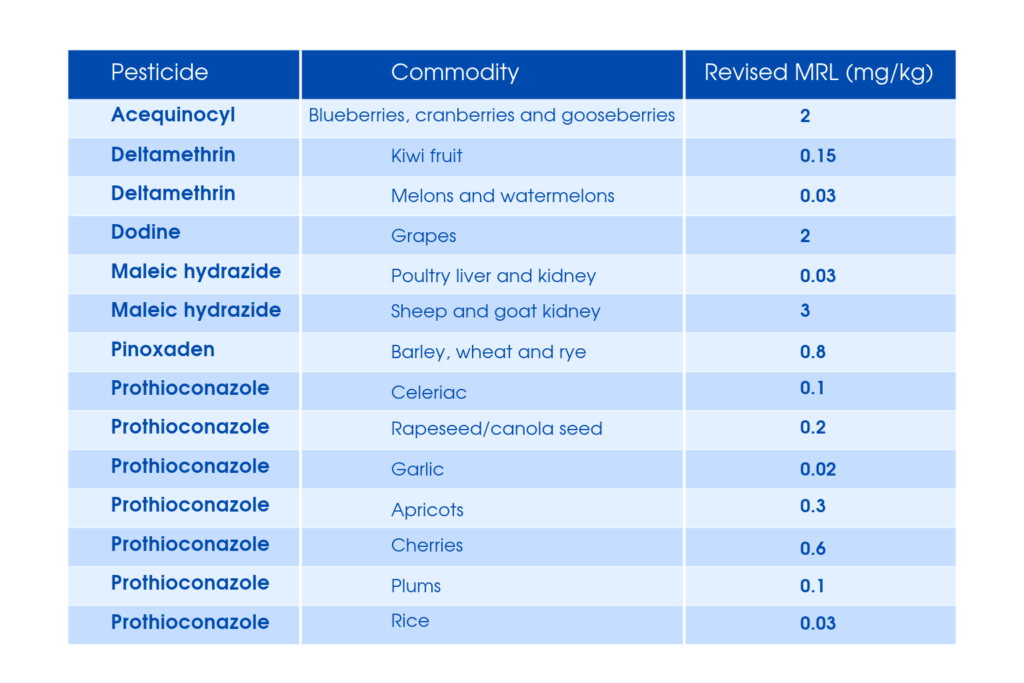
Important analytical detail: residue definitions
For example:
- Deltamethrin: The regulation specifies deltamethrin (cis-deltamethrin).
- Pinoxaden: The relevant residue definition includes the sum of M4 and M6, both free and conjugated, expressed as pinoxaden.
- Prothioconazole: The relevant plant-commodity residue definition includes prothioconazole-desthio, expressed as the sum of isomers.
What the Changes Mean for Food Exporters
- Fresh fruit and vegetable exporters
Businesses exporting blueberries, cranberries, currants, gooseberries, kiwi fruit, melons, watermelons, grapes, celeriac, garlic, apricots, cherries and plums should review whether the updated pesticide limits affect their products.
The relevant pesticide and commodity combination must be checked individually. A change to one pesticide’s MRL does not automatically change the permitted level of other pesticide residues in the same commodity.- Cereal and oilseed exporters
The revised pinoxaden MRLs for barley, wheat and rye, together with the prothioconazole provisions for rapeseed/canola seed, are relevant to businesses exporting these commodities or using them as ingredients.
Exporters should verify residue-monitoring plans against the applicable residue definitions and the requirements of their buyers.- Rice exporters
The revised prothioconazole MRL for rice is particularly relevant to rice supply chains where this active substance may be used or where residue contamination is identified as a potential risk.
The relevant EU MRL should be checked before shipment, and testing should be selected according to the applicable residue definition and the required reporting capability.- Animal-derived food businesses
The regulation also revises specified maleic hydrazide MRLs in products of animal origin and confirms certain tentative pinoxaden MRLs.
Businesses involved in meat, offal, milk or egg supply chains should review the precise commodity entries rather than applying a single limit across all animal-derived products.Pesticide Residue Testing: Analytical Requirements
- Multi-residue analysis using LC-MS/MS and GC-MS/MS
Liquid chromatography–tandem mass spectrometry (LC-MS/MS) and gas chromatography–tandem mass spectrometry (GC-MS/MS) are widely used for pesticide residue analysis.
Depending on the substance and validated method, these techniques can support the identification and quantification of multiple pesticide residues in a single analytical workflow. LC-MS/MS is suitable for many polar, non-volatile or thermally sensitive pesticide compounds and relevant metabolites.GC-MS/MS is suitable for pesticides that can be analysed using gas chromatography, subject to the method’s chemical and instrumental requirements.
Neither technique automatically covers every pesticide or residue definition. The method must be evaluated for the specific analytes and matrix.- QuEChERS sample preparation
QuEChERS — Quick, Easy, Cheap, Effective, Rugged and Safe — is a commonly used sample-preparation approach for multi-residue pesticide analysis in many food matrices.
It generally involves extraction with a suitable solvent followed by partitioning and, where required, dispersive solid-phase extraction clean-up. The specific procedure may require modifications depending on the food matrix, analyte properties and method performance requirements.- Method performance and reporting limits
For export-compliance testing, method suitability should consider:
- The applicable EU MRL and legal residue definition.
- The analytical method’s limit of quantification (LOQ).
- Recovery and precision.
- Matrix effects and potential interferences.
- Identification criteria and confirmation requirements.
- Relevant quality-control measures.
- Measurement uncertainty and the applicable decision rules.
Sampling: A Critical Part of Compliance
Pesticide residue results are only as representative as the sample tested. Residues can vary between individual fruits, field lots, production sites, harvest dates and batches.
A robust sampling programme should consider:- Lot identification: Clearly identify the consignment, commodity, origin, production lot and relevant traceability details.
- Representative sampling: Use a suitable sampling procedure for the commodity and intended compliance assessment.
- Sample handling: Prevent contamination during collection, packaging, storage and transport.
- Sample preparation: Ensure that the laboratory prepares the sample according to the applicable commodity-specific method and residue definition.
- Documentation: Maintain traceability between the tested sample, analytical report, supplier and export consignment.
Practical Steps to Prepare for the 5 November 2026 Implementation Date
- Review pesticide use and supplier information
- Map commodities to applicable MRLs
- Update residue-monitoring plans
- Confirm laboratory method suitability
- Review consignments around the effective date
- Investigate non-compliant results
- Maintain traceability and records
Common Mistakes in EU Pesticide MRL Compliance
- Using national pesticide limits instead of verifying the destination-market MRL.
- Applying a single limit to all commodities or all pesticides.
- Confusing an MRL with a pesticide authorisation or a toxicological reference value.
- Testing only the parent compound when the legal residue definition includes metabolites.
- Selecting an analytical method without checking its LOQ against the applicable limit.
- Assuming that one compliant sample proves compliance across every batch.
- Using outdated MRL tables or supplier specifications.
- Treating the publication date and the date of application as interchangeable.
How Eureka Supports Pesticide Residue Testing
- Pesticide residue analysis: Testing for selected pesticide residues in relevant food and agricultural commodity matrices.
- Multi-residue testing: Analytical assessment of multiple pesticide residues using suitable validated methods.
- Export-oriented testing plans: Assistance in identifying relevant testing parameters based on commodity, destination market and customer requirements.
- Analytical reporting: Results to support supplier verification, quality-control investigations and compliance assessment.
- Result interpretation support: Assistance in understanding reported concentrations in relation to the selected method and specified requirements.
Conclusion
Frequently Asked Questions (FAQ)
1. What is Commission Regulation (EU) 2026/2289?
2. When do the revised pesticide MRLs apply?
3. Which pesticides are covered by the update?
4. Which commodities are affected?
5. What is the difference between an MRL and a pesticide authorisation?
6. Which analytical techniques are used for pesticide residue testing?
7. Is QuEChERS suitable for every pesticide and food matrix?
8. Why is the LOQ important in pesticide residue testing
9. Can a product comply with Indian limits but fail EU requirements?
10. What should exporters do before shipping affected commodities?
Official References
- Commission Regulation (EU) 2026/2289 amending Annex II to Regulation (EC) No 396/2005
- Regulation (EC) No 396/2005 on maximum residue levels of pesticides in or on food and feed of plant and animal origin
- European Food Safety Authority (EFSA) — Pesticide Residue Risk Assessment and MRL Applications
- European Commission — Pesticides and Maximum Residue Levels
- European Commission — EU Coordinated Multiannual Control Programme for Pesticide Residues
- SANTE Guidance Document on Analytical Quality Control and Method Validation Procedures for Pesticide Residues Analysis in Food and Feed