Introduction
- Potato-based foods
- Bread and bakery products
- Biscuits and cookies
- Breakfast cereals
- Coffee and coffee substitutes
- Crackers and crisp breads
- Cereal-based snacks
- Certain processed foods
What Is Acrylamide?
The main formation pathway involves the reaction between:
Reducing sugars + Asparagine + Heat → Acrylamide
The reaction becomes particularly relevant during processing temperatures generally above approximately 120°C under low-moisture conditions.
Consequently, processing conditions can have a significant effect on the final acrylamide concentration.Why Is Acrylamide a Food-Safety Concern?
The toxicological concern surrounding acrylamide is primarily related to its potential genotoxicity and carcinogenicity.
EFSA’s scientific assessment concluded that dietary exposure to acrylamide is a concern with respect to carcinogenic effects.- Amount consumed
- Frequency of consumption
- Acrylamide concentration in the food
- Individual dietary patterns
- Age and exposure duration
How Does Acrylamide Form in Food?
- Asparagine
- Glucose
- Fructose
- Other reducing sugars
Foods Commonly Associated with Acrylamide
Potato-Based Products
Examples include:
- French fries
- Potato chips
- Potato crisps
- Other fried potato products
Cereal-Based Products
Examples include:
- Bread
- Biscuits
- Cookies
- Crackers
- Breakfast cereals
- Cereal snacks
- Bakery products
EU Regulatory Framework for Acrylamide
Commission Regulation (EU) 2017/2158 of 20 November 2017 establishing mitigation measures and benchmark levels for the reduction of the presence of acrylamide in food.
The regulation is currently in force and establishes measures that food business operators must apply to reduce acrylamide formation.- Mitigation measures
- Benchmark levels
- Monitoring requirements
- Sampling and analysis provisions
- Responsibilities for food business operators
Benchmark Levels Are Not Maximum Legal Limits
This distinction is extremely important.
The EU acrylamide values are referred to as benchmark levels, rather than conventional maximum legal limits.A benchmark level is used as an indicator for assessing whether mitigation measures are effective and whether further reduction should be considered.
Therefore:
Exceeding a benchmark level does not automatically mean that a food is illegal.
However, a result above the applicable benchmark should trigger appropriate review of the mitigation measures and processing controls.
Food businesses should therefore avoid describing EU acrylamide benchmark levels as simple “maximum permitted limits.”EU Acrylamide Benchmark Levels
The EU framework establishes benchmark levels for specific food categories.
Examples of categories covered include: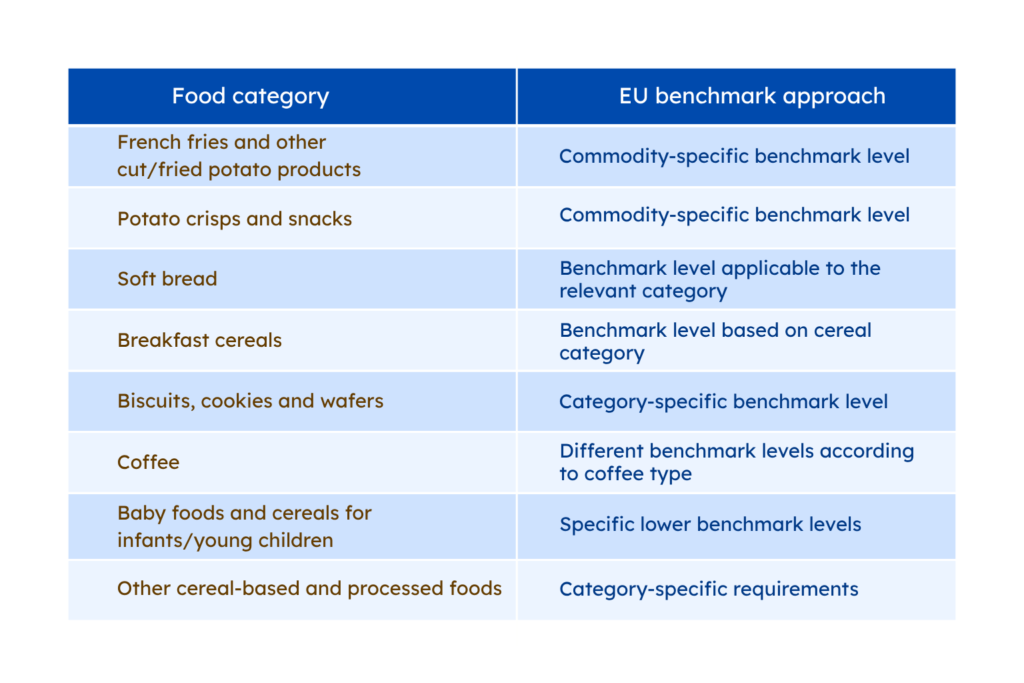
EU Mitigation Measures
- Raw material selection
- Agricultural practices
- Recipe composition
- Ingredient selection
- Processing temperature
- Processing time
- Moisture
- Frying conditions
- Baking conditions
- Roasting conditions
- Finished-product colour
- Storage and preparation conditions
Raw Material Selection
For example, potato varieties can differ in their levels of reducing sugars and therefore their acrylamide-forming potential.
Similarly, cereal ingredients can vary in their composition. Manufacturers may therefore consider:- Raw material specifications
- Supplier qualification
- Variety selection
- Storage conditions
- Seasonal variability
- Reducing sugar levels
- Asparagine-related risk
Processing Controls for Acrylamide Reduction
Control of:
- Frying temperature
- Frying time
- Oil condition
- Potato preparation
- Final product colour
Baking
Controls may include:
- Baking temperature
- Baking time
- Dough formulation
- Moisture
- Product thickness
- Final colour
For coffee and other roasted products, roasting conditions can significantly influence acrylamide formation.
Recipe Optimisation Reducing acrylamide precursors or using suitable ingredients may help lower formation without compromising product quality.Why Product Colour Can Matter
In certain food categories, excessive browning can be associated with increased acrylamide formation.
Therefore, controlling the final degree of browning can be one practical mitigation measure.
However, colour alone cannot be used as a substitute for laboratory testing.
Two products with similar visual appearance can have different acrylamide concentrations depending on raw materials and processing history.Acrylamide Testing
- Product development
- Process validation
- Supplier qualification
- Routine quality control
- Regulatory monitoring
- Export compliance
- Investigation of elevated results
- Verification of mitigation measures
Analytical Methods for Acrylamide
Liquid Chromatography-Tandem Mass Spectrometry (LC-MS/MS) is a highly selective technique that can be used for trace-level acrylamide determination in food matrices.
It is suitable for a wide range of food products when supported by an appropriate validated method.Method Selection
The analytical method should be appropriate for:
- Food matrix
- Expected concentration
- Required reporting limit
- Applicable regulatory or customer requirement
- Laboratory validation status
Important Analytical Considerations
Acrylamide testing requires appropriate sample preparation and analytical controls.
Important performance characteristics include:- Specificity
- Selectivity
- Accuracy
- Precision
- Recovery
- Linearity
- Limit of Detection (LOD)
- Limit of Quantification (LOQ)
- Matrix effects
- Measurement uncertainty
- Quality-control performance
Sampling Is Important
A representative sample is essential for meaningful acrylamide analysis.
The sample should represent the production batch or lot being assessed.
Sampling considerations may include:- Batch size
- Product variability
- Different production lines
- Different processing conditions
- Packaging or lot segregation
- Homogenisation requirements
Risk-Based Acrylamide Monitoring
Acrylamide testing should ideally form part of a broader risk-management programme.
A practical approach is:Raw Material Assessment
↓
Identify Acrylamide Formation Potential
↓
Review Formulation
↓
Optimise Processing Conditions
↓
Laboratory Testing
↓
Compare Result With Applicable Benchmark / Specification
↓
Investigate Elevated Results
↓
Implement Corrective Measures
↓
Verify Through Follow-Up TestingWhat If Acrylamide Levels Are High?
An elevated acrylamide result should trigger an investigation rather than simply repeating the same test.
Potential investigation areas include:Raw Materials
- High reducing sugar levels
- High asparagine
- Supplier variability
- Storage-related changes
Processing
- Excessive temperature
- Excessive processing time
- Uneven heating
- Excessive browning
Formulation
- Ingredient composition
- Sugar sources
- Recipe changes
- Processing aids
Equipment
- Fryer temperature control
- Oven calibration
- Roasting conditions
- Heat distribution
Sampling
- Batch variability
- Sampling location
- Homogenisation
Acrylamide and Food Export Compliance
Acrylamide is particularly important for businesses exporting processed foods to the European market.
Products that may require consideration include:- Potato snacks
- Biscuits
- Bakery products
- Breakfast cereals
- Coffee
- Cereal-based foods
- Processed potato products
- Infant and young-child foods
Exporters should not rely only on general food-safety certificates.
Where acrylamide is relevant to the destination-market requirements or buyer specification, product-specific analytical evidence and process controls may be necessary.Acrylamide Requirements in India
India’s regulatory framework for acrylamide continues to develop.
FSSAI currently lists “Limits of Acrylamide as a contaminant in food chain” among standards under development.
FSSAI has also conducted national food surveys involving acrylamide, demonstrating regulatory and surveillance interest in this process contaminant.
Therefore, Indian manufacturers supplying domestic and export markets should monitor applicable FSSAI developments while separately assessing destination-market requirements.
For export-oriented businesses, EU requirements may currently be more operationally significant because the EU has an established acrylamide mitigation and benchmark-level framework.Acrylamide vs Other Food Contaminants
Acrylamide differs from contaminants such as:
Mycotoxins: Primarily produced by moulds.
Pesticide residues: Result from agricultural pesticide use.
Heavy metals: May originate from environmental contamination, raw materials or processing.
Acrylamide: Primarily forms during thermal processing through chemical reactions between naturally occurring food components.
This distinction is important because acrylamide control requires strong process optimisation, not only raw-material testing.How Eureka Supports Acrylamide Testing
- Potato-based snacks
- French fries and processed potato products
- Biscuits and cookies
- Bakery products
- Bread
- Breakfast cereals
- Cereal-based snacks
- Coffee and roasted products
- Other thermally processed foods
- Product development
- Raw-material qualification
- Process optimisation
- Routine quality monitoring
- Benchmark-level assessment
- Export compliance
- Customer specification testing
- Investigation of elevated results
- Verification of mitigation measures
Building an Effective Acrylamide Control Programme
Track results over time to identify changes between:
- Suppliers
- Seasons
- Production batches
- Manufacturing sites
- Processing conditions
Key Takeaways
- Acrylamide is a process contaminant that can form when certain foods are heated at high temperatures.
- Formation is primarily associated with reactions between reducing sugars and asparagine.
- Potato products, cereal-based foods and coffee are important contributors to dietary acrylamide exposure.
- The EU regulates acrylamide through mitigation measures and benchmark levels under Commission Regulation (EU) 2017/2158.
- EU acrylamide benchmark levels should not be described as conventional maximum legal limits.
- Exceeding a benchmark level should prompt review of the effectiveness of mitigation measures.
- Raw material composition and processing conditions can strongly influence acrylamide formation.
- Laboratory testing is important for verifying the effectiveness of mitigation measures.
- LC-MS/MS can provide sensitive and selective acrylamide analysis.
- India is developing standards relating to acrylamide as a contaminant in the food chain.
- Exporters should evaluate acrylamide requirements according to the destination market and product category.
Frequently Asked Questions (FAQ)
1. What is acrylamide in food?
2. Which foods contain acrylamide?
3. How does acrylamide form?
4. Is acrylamide a legal limit in the EU?
5. What is the EU regulation for acrylamide?
6. What are EU acrylamide benchmark levels?
7. How can manufacturers reduce acrylamide?
8. How is acrylamide tested in food?
9. Is acrylamide testing required for all foods?
10. Can Eureka test food products for acrylamide?
Official References
- Commission Regulation (EU) 2017/2158 – Mitigation Measures and Benchmark Levels for the Reduction of the Presence of Acrylamide in Food
- Commission Recommendation (EU) 2019/1888 – Monitoring of the Presence of Acrylamide in Certain Foods
- European Commission – Acrylamide in Food
- European Food Safety Authority (EFSA) – Acrylamide
- FSSAI – Food Safety and Standards (Contaminants, Toxins and Residues) Regulations, 2011, as amended
- FSSAI – List of Standards Under Development: Acrylamide as a Contaminant in Food Chain
- Codex Alimentarius – Code of Practice for the Reduction of Acrylamide in Foods (CXC 67-2009)