Introduction
What Is SPF Testing?
- SPF 15
- SPF 30
- SPF 50
- SPF 50+
What Is UVA Protection?
UVB is strongly associated with:
- Sunburn
- Erythema
- Direct DNA damage
UVA penetrates deeper into the skin and is associated with:
- Photoageing
- Oxidative stress
- Long-term skin damage
- Contribution to skin cancer risk
Therefore, a sunscreen assessment should not focus only on SPF.
A product can have a high SPF while providing inadequate UVA protection if the formulation does not provide appropriate broad-spectrum protection.
For this reason, SPF and UVA protection should be considered complementary aspects of sunscreen efficacy.Traditional In-Vivo SPF Testing
The SPF is then calculated from the corresponding UV exposure required to produce a defined erythemal response.
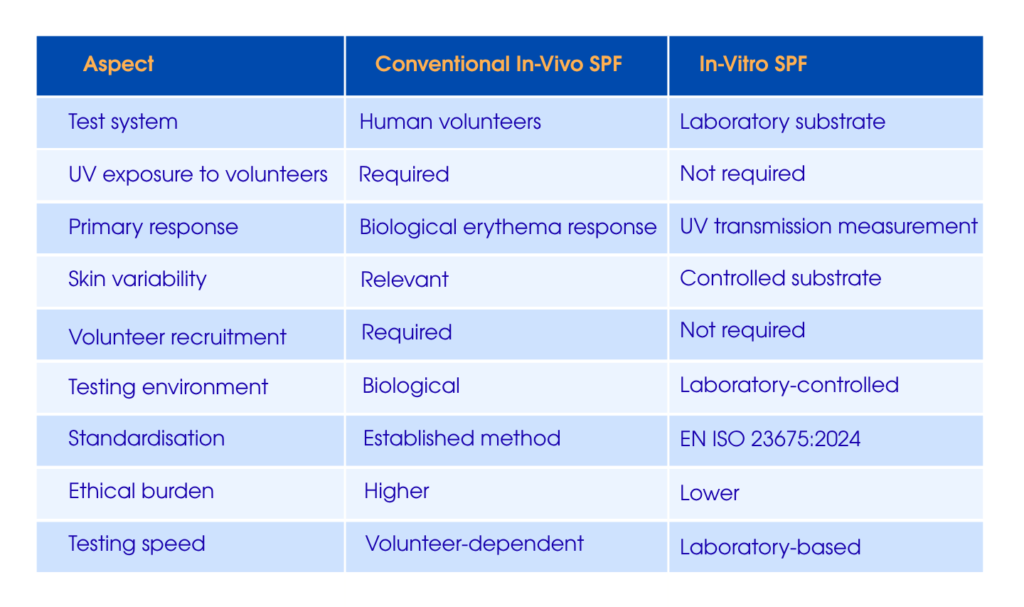
The conventional approach has provided an established means of assessing sunscreen efficacy, but it has limitations.- Requires human volunteers
- Exposure to UV radiation is necessary
- Volunteer skin characteristics can influence results
- Testing can be time-consuming
- Volunteer availability can limit testing
- Ethical considerations arise from deliberate UV exposure
The Shift Toward In-Vitro SPF Testing
The method measures UV transmission through a controlled sunscreen film applied to specialised substrates.
The European Commission’s 2026 comparison found a high correlation between the in-vitro method and conventional in-vivo SPF results for the products assessed.
This provides important evidence supporting broader adoption of non-invasive sunscreen efficacy testing.How Does In-Vitro SPF Testing Work?
- A moulded plate
- A sandblasted plate designed to reproduce relevant surface characteristics
Parameters such as:
- Amount of product applied
- Application technique
- Temperature
- Drying time
- Product film formation
A standardised robotic application system is used to produce a reproducible sunscreen film.
A spectrophotometer then measures how much UV radiation passes through the sunscreen layer.
The measured UV transmission is used in the calculation of the SPF.Why Is In-Vitro SPF Testing Important?
In-Vivo vs In-Vitro SPF Testing
What Did the 2026 EU Sunscreen Testing Campaign Show?
The campaign:
- Tested 74 sunscreen and day-cream products
- Involved market-surveillance authorities from 11 EU countries
- Compared conventional in-vivo SPF testing with the newer in-vitro method
- Used EN ISO 23675:2024 for the in-vitro assessment
The Commission reported a high level of correlation between the in-vitro and conventional in-vivo SPF results for the products assessed.
This evidence supports a broader shift toward testing approaches that can demonstrate sunscreen efficacy without exposing volunteers to UV radiation.
However, the campaign does not mean that every existing sunscreen testing requirement has automatically been replaced by EN ISO 23675:2024.
Manufacturers should determine the applicable testing strategy based on the product, claim, destination market and current regulatory/standardisation requirements.What About UVA Testing?
UVA protection testing is also important for demonstrating broad-spectrum protection.
The European Commission’s sunscreen framework states that sunscreen products should provide protection against dangerous UV radiation and that efficacy claims should be based on standardised and reproducible criteria.UVA assessment may consider parameters such as:
- UVA protection factor
- Critical wavelength
- UVA/UVB protection balance
- Spectral absorbance
UVA In-Vitro Testing
A commonly recognised approach for in-vitro UVA protection assessment is based on ISO 24443, which determines UVA protection characteristics from the spectral absorbance of a sunscreen film.
The method can provide information relevant to:- UVA protection factor
- UVA spectral profile
- Critical wavelength
- Broad-spectrum performance
SPF and UVA Should Be Assessed Together
A modern sunscreen efficacy programme should consider both:
SPF → Primarily UVB/erythema protection
andUVA testing → UVA protection characteristics
A product intended to provide broad-spectrum protection should therefore have an efficacy-testing strategy that supports the relevant claims.
This is particularly important for products marketed with claims relating to:
- High UV protection
- Broad-spectrum protection
- UVA protection
- Anti-photoageing protection
- Daily UV protection
- Sensitive-skin sun protection
EU Regulatory Framework for Sunscreens
Sunscreens marketed in the European Union are regulated as cosmetic products under Regulation (EC) No 1223/2009 on cosmetic products.
Sunscreen efficacy claims are also addressed by the European Commission’s Recommendation on the efficacy of sunscreen products and the claims made relating thereto, adopted in 2006.The Recommendation addresses:
- Sunscreen efficacy
- Minimum protection expectations
- Claims
- Labelling
- Consumer information
- Application instructions
UV Filters and Product Safety
Sunscreen efficacy cannot be separated from ingredient safety.
UV filters used in EU cosmetic products must comply with the applicable requirements of the EU Cosmetics Regulation.The European Commission notes that UV filters must be assessed and authorised before use in sunscreen products.
Therefore, sunscreen compliance involves two distinct but related areas:Does the finished product provide the level of SPF/UVA protection claimed?
A product should satisfy both aspects.Sunscreen Testing Beyond SPF and UVA
A comprehensive sunscreen testing programme may involve more than SPF and UVA efficacy.
Depending on the product and claims, manufacturers may also consider:- Water Resistance
- Photostability
- Stability
- Microbiological Quality
- Preservative Efficacy
- Packaging Compatibility
Limitations of the Current In-Vitro SPF Approach
Therefore, manufacturers should assess:
- Product format
- Formulation
- Intended claim
- Applicable standard
- Destination-market expectations
- Available validated methods
Why Standardisation Matters
Important variables can include:
- Product application amount
- Film thickness
- Substrate characteristics
- Application technique
- Drying time
- Temperature
- UV source
- Spectral measurement
- Calculation procedure
- Instrument calibration
Small differences in methodology can influence reported efficacy values.
Standardised testing therefore helps improve comparability, reproducibility and confidence in sunscreen claims.Implications for Sunscreen Manufacturers
- Review Existing Testing Strategies
- Evaluate In-Vitro Options
- Strengthen UVA Assessment
- Align Claims With Evidence
- Maintain Technical Documentation
- Monitor Standardisation Developments
How Eureka Supports Sunscreen Testing
Eureka can support cosmetic manufacturers, sunscreen brands and product developers with analytical and efficacy-testing requirements related to sunscreen products.
Depending on the product, claim and applicable analytical scope, testing support may include:- SPF Testing
- UVA Testing
- Product Quality Testing
- Stability-Related Testing
- Regulatory Support Testing
Testing programmes designed around:
- EU cosmetic requirements
- Product claims
- Customer specifications
- Export-market requirements
- Product development needs
Practical Sunscreen Testing Workflow
Define Product & Claims
↓
Identify Applicable EU / Destination-Market Requirements
↓
Review UV Filters & Formulation
↓
Select SPF Testing Method
↓
Select UVA Testing Method
↓
Assess Additional Claims
↓
Conduct Laboratory Testing
↓
Evaluate Results Against Applicable Criteria
↓
Substantiate Product Claims
↓
Maintain Technical DocumentationKey Takeaways
- Sunscreen efficacy testing is evolving toward more standardised and non-invasive approaches.
- The European Commission's September 2026 market-surveillance campaign compared conventional in-vivo SPF testing with EN ISO 23675:2024 in-vitro testing across 74 products from 11 EU countries.
- The Commission reported a high correlation between the in-vitro and conventional in-vivo results for the products assessed.
- The Commission has advised manufacturers to prioritise testing approaches that avoid harmful UV exposure to human volunteers where appropriate.
- SPF and UVA protection represent different aspects of sunscreen performance.
- ISO 24443 is an important standardised approach for in-vitro UVA protection assessment.
- EU sunscreen products fall under the EU Cosmetics Regulation (EC) No 1223/2009.
- Sunscreen claims should be supported by standardised and reproducible efficacy evidence.
- In-vitro testing is not yet a universal solution for every sunscreen format; the European Commission specifically identifies limitations for sticks and powders.
- Water-resistance claims require appropriate testing and remain an area where further standardisation is relevant.
- Manufacturers should periodically review SPF/UVA testing strategies as standards and regulatory expectations evolve.
Frequently Asked Questions (FAQ)
1. What is SPF testing?
2. What is in-vitro SPF testing?
3. What is EN ISO 23675:2024
4. Is in-vitro SPF testing replacing all human SPF testing in the EU?
5. What is the difference between SPF and UVA testing?
6. What is ISO 24443 used for?
7. Can all sunscreen products be tested using the new in-vitro SPF method?
8. Why is in-vitro SPF testing considered more ethical?
9. Does a high SPF automatically mean strong UVA protection?
10. Can Eureka support SPF and UVA testing?
Official References
- Regulation (EC) No 1223/2009 on Cosmetic Products
- European Commission – Recommendation on the efficacy of sunscreen products and the claims made relating thereto (2006/647/EC)
- European Commission – Sunscreen Products
- European Commission – EU Moves to More Ethical Sunscreen Testing (15 September 2026)
- EN ISO 23675:2024 – Cosmetics — Sun protection test methods — In vitro determination of sun protection factor (SPF)
- ISO 24443 – Determination of Sunscreen UVA Photoprotection In Vitro
- ISO 24444 – Cosmetics — Sun Protection Test Methods — In Vivo Determination of Sun Protection Factor (SPF)
- SCCS Notes of Guidance for the Testing of Cosmetic Ingredients and Their Safety Evaluation, 12th Revision
- European Commission / SCCS – Scientific Opinions on UV Filters